
Key Questions: How Will the U.S. Adapt to a New Era of Power Demand Fueled by Relentless AI Growth?
The Key Wealth Institute is a team of highly experienced professionals representing various disciplines within wealth management who are dedicated to delivering timely insights and practical advice. From strategies designed to better manage your wealth, to guidance to help you better understand the world impacting your wealth, Key Wealth Institute provides proactive insights needed to navigate your financial journey.
Power generation remains an evolving investable theme spanning multiple sectors and industry groups such as electrical equipment, energy storage, and independent power producers (IPPs), among others.
Among the most consequential challenges unfolding across the country today is the rapid rise in power demand and the strain it could place on the U.S. electric grid. The need for additional power has been largely driven by the parabolic growth in the build-out of artificial intelligence (AI) in recent years, a trend that is not expected to slow anytime soon. The question of how to meet this demand has created an increasingly complex dynamic among utility providers, hyperscalers, regulators, and the broader public.
Electric utility companies, already under pressure due to the aging condition of the current infrastructure, have not seen this pace of demand growth in several decades. At the same time, there is growing concern that the proliferation of data centers and other energy-intensive AI developments could have a negative impact on utility customers. Additional stress on the grid could result in higher costs, lower reliability, or some combination of the two. Recognizing these concerns, some government officials have lobbied for consumer protections or even instituted moratoriums on the development of AI infrastructure projects altogether. Beneath these debates lies a larger reality: the rise of new technology is reshaping the nation’s power needs, creating what may become one of the defining infrastructure challenges of the coming decades.

Line graph titled “U.S. Electricity Consumption Index 1949–2050.” Historical electricity consumption rises from an index of 1 in 1949 to approximately 16 in the early 2020s. Forecasts then diverge through 2050: McKinsey projects the steepest increase to about 33, NEMA projects growth to about 25, and the EIA projects a more gradual rise to about 20. The index uses 1949 as the baseline value of 1.0.
Electric utility companies enter this situation in a complicated position. They must maintain the ability to provide reliable power while keeping consumer prices manageable. Utility providers face regulatory, operational, and financial constraints in bringing new power generation capacity online, often requiring years of permitting and approval processes. Further rate increases could be challenging as utility customers have already absorbed price increases due to the recent inflationary environment and ongoing upgrade cycle required to modernize outdated transmission infrastructure.
The speed at which AI is expanding conflicts directly with these limitations. The rapid growth in AI adoption and utilization has accelerated the need for compute infrastructure and the electricity required to power it. Furthermore, the scale of demand presents a challenge in its own regard. AI-related demand is not replacing pre-existing power needs but rather compounding them, putting pressure on utility systems that were not designed for such sudden growth. While AI likely represents the strongest opportunity for utilities to grow earnings since the widespread adoption of air conditioning in the mid-1900s, the unprecedented rate of growth creates issues given the need for robust investment and the associated funding. This delicate ecosystem has necessitated innovation on the part of cloud providers seeking to secure power capacity despite the obstacles they now face.
Constraints faced by utility providers are only one part of the story. The hyperscalers leading the AI buildout must also grapple with public backlash and a byzantine regulatory environment. These companies are actively working to find solutions that do not push utility companies beyond their means while also preventing additional costs from being passed onto the ratepayers. One such solution that has gained traction among cloud providers is the “bring your own power,” or BYOP, trend.
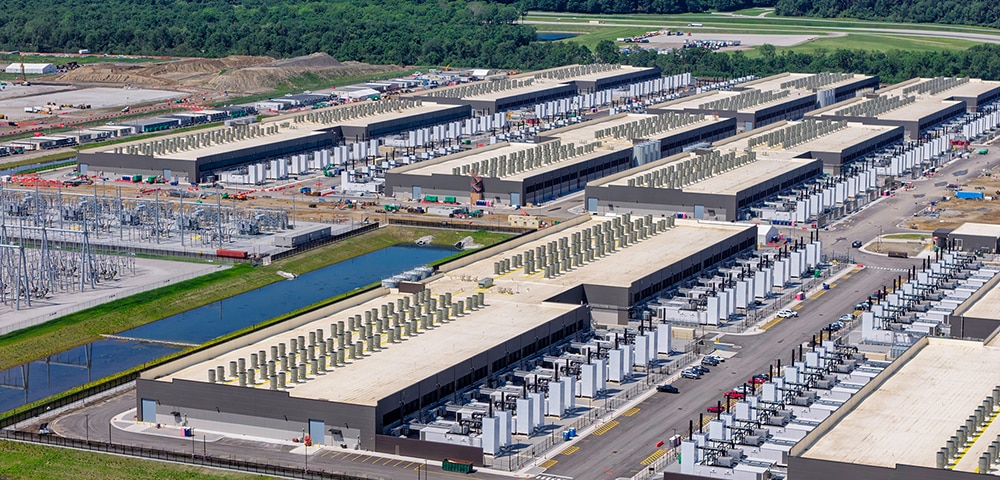
For decades, large industrial customers could assume that utilities would deliver the electricity they needed. Today, that assumption is breaking down. Data centers require hundreds of megawatts, and in some cases more than a gigawatt,1 of continuous power. Given the constraints outlined earlier, the process of upgrading the grid to accommodate such immense consumption could take years. For a hyperscaler racing to deploy AI infrastructure, waiting for grid connectivity could prove more costly than financing a dedicated power solution.
The response has been a growing embrace of BYOP strategies. Rather than depending solely on utility service, developers are pairing data centers with dedicated power-generating assets. These builds may include on-site natural gas plants, behind-the-meter generation, co-location with existing power stations, nuclear partnerships, or combinations of solar and battery storage. Such arrangements allow cloud providers to source the necessary energy without being slowed by regulatory hurdles and utility backlogs.
Dedicated power can also improve reliability and reduce the risk that massive new demand loads strain the broader electric system. In this scenario, self-supplied generation enables economic development without forcing households and businesses to subsidize the costs associated with powering data centers. For that reason, many cloud providers view BYOP as an equitable resolution to concerns related to rising power demand.
For consumers, however, significant concerns remain. Self-supplied generation may solve the energy problem, but the expansion of data centers and power plants throughout the country creates additional challenges. The environmental impact, water consumption, land use, and emissions associated with these projects could all weigh on surrounding communities. The “not in my backyard” sentiment towards data center development, commonly known as NIMBYism, has grown increasingly prevalent as residents have opposed local AI infrastructure projects. As a result, regulators are caught in a difficult position. On one hand, embracing the AI build-out could become a matter of economic competitiveness. On the other hand, officials must prioritize the well-being of the community.
The rise of bring-your-own power is about far more than data centers. It reflects a broader reality: the United States is entering an era in which energy availability increasingly determines where and how economic growth occurs. Finding ways to attract investment and expand power generation while maintaining public support will be crucial for long-term success. In our view, the decisions being made today by key stakeholders will establish a significant precedent for how the new era of power demand in the United States will be addressed over the long-term.
For more information, please contact your advisor.