The promise of humanoid robots is driving investment in physical AI
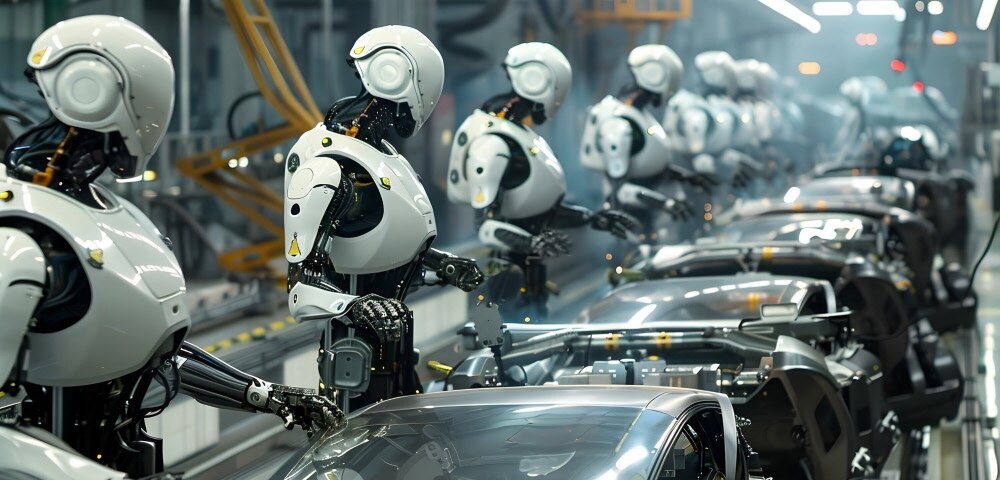
The dream of fully autonomous, human-like robots is still a long way from becoming reality. But growing interest in humanoids — autonomous machines that use AI models to perceive, reason and act in the real world — is catalyzing investment in the broader category of physical AI.
Industry leaders recently gathered in Boston for the annual KeyBanc Capital Markets Industrials & Basic Materials Conference, which included a panel discussion on the State of Humanoids. Moderator Trevor Upton, sector head for physical AI with KeyBanc Capital Markets’ Mosaic group, spoke with a panel of experts with diverse perspectives across robotics, autonomy, and automation.
The panelists were:
- Craig Cheney, Co‑founder and CEO of Strive Robotics
- Dan Burseth, Chief Revenue Officer at GrayMatter Robotics
- Jon Duren, Senior Sales Practice Manager for AI and Data Solutions at World Wide Technology
- Çetin Meriçli, Co-founder and CEO of Atlas Robotics
Robotics investment surges
Upton noted that humanoids generate a unique degree of excitement at the intersection of physical AI, sensors, and robotics. “Humanoids represent a form factor that captures the imagination unlike any other form factor, and I find expectations of what humanoids can do sometimes seem to relate more closely to what humans can do than to what machines-shaped-like-humans can do,” he said.
Investment is pouring into the robotics industry as automation technology breaks new ground. Venture capital funding of robotics and physical AI grew from $4.2 billion globally in 2019 to $27.7 billion in 2025, according to PitchBook data.1 VC funding of humanoid startups totaled more than $5 billion in the first four months of 2026, exceeding last year’s annual total, PitchBook found.2
Humanoids have a wide range of proposed applications, including customer service, healthcare, manufacturing, and search and rescue missions. Opinions are mixed about how useful humanoids will prove in these settings, but industry leaders see significant near-term opportunities related to all forms of physical AI. Panelists expect an unprecedented pace of research evolution, tech advancement, and industry adoption over the next 12 to 24 months.
Companies need the right tool for the job
Manufacturing and logistics companies show how interest in humanoids is generating opportunities for practical automation solutions. Many companies are investing in automation and robotics to replace roles that pose safety risks for humans. In addition, the spike in demand from industries such as defense and data centers is driving an urgent quest for automation to massively increase throughput.
“Companies typically express interest in humanoids because they feel that this type of robot will operate more seamlessly alongside their human workforce,” said Jon Duren of World Wide Technology. “They also seek robots that can function well in workstations that were designed around the bipedal human form.”
However, robots with a human form factor are rarely suited for factories or warehouses, because they can’t lift or carry much weight. There is almost always a form factor alternative to humanoids that is far better suited for a given customer’s needs.
Duren once worked with a customer to develop a modified humanoid resembling a torso on a rolling platform. Unlike a bipedal humanoid, the robot can lift heavy materials off the floor due to its low center of gravity, while its articulated arms enable human-like manipulation of materials.
Full autonomy is still out of reach
While Fortune 500 enterprises are investing heavily in robotic automation, panelists see the real opportunity in middle-market businesses. These companies may be less technologically mature, but they are often hungrier and faster to evolve. Panelists stated that middle-market innovators that can figure out how to unlock real value from robotics and automation in their lines of business may have the ability to leapfrog larger competitors.
Successful adoption does, however, require realistic expectations. Dan Burseth with GrayMatter Robotics, a factory automation leader, noted that Carnegie Mellon researchers drove a car autonomously from Pittsburgh to San Diego in 1995. More than 98% of the drive was accomplished without human intervention, using groundbreaking self-driving technology. In the 30 years since, roughly $220 billion of development capital has been deployed to solve that last 1.8% of autonomy.
The lesson is that achieving perfect autonomy poses huge, asymptotically increasing costs and challenges. Manufacturers and other companies should aim for automation solutions that are cost-effective and low risk, with a proven track record. A solution that delivers 85% or even 75% autonomy often satisfies business needs while enabling skilled workers to continue to play a valuable role for years or decades to come.
While physical AI has the potential to transform labor-intensive industries, major challenges remain on the path to autonomy, including robot implementation and the collection and scaling of high-quality training data.
Panelists agreed that we’re still a long way from fully autonomous robots, but they’ve never been more excited about how the field is progressing.
“Now, for the first time, I think we have all of the basic ingredients in our overall toolbox to build truly intelligent machines, maybe not at the superintelligence or AGI level, but at least [at the level of] domain generalists, domain experts,” said Çetin Meriçli of Atlas Robotics. “About 80% of the entire world's economy is in the built world. It's tens of trillions of dollars, and even if you think that physical AI will have only 5% disruption over the next 5-10 years, that's $10 trillion a year.”
Craig Cheney of Strive Robotics added, “Getting towards fully autonomous [robots] — 100% autonomous with no human intervention — is still quite a long way off. We need to expect to have humans in the loop on the data collection side as well as the implementation side for many years to come.”
What is indisputable is the fact that AI and robotics are already disrupting and reshaping industrial workflows today. They’re creating a rare window for forward-looking middle-market innovators, and the banks that serve them, to unlock real value.
Connect With Us
To discuss how robotics and humanoids are disrupting traditional industries, connect with Trevor Upton or another member of KeyBanc Capital Markets Mosaic group.